
Thoughts, You Just Fold Them In



Just Fold Them In
August 1, 2025
RIF Day 2025
Today marks the end of an era for 1,400 civil servants at the U.S. Department of Education. For me, that means 9 years, 4 months, and 13 days of public service—cut short. Since March, we’ve been unable to do the work we were hired to do, and now, with final reductions taking effect, the public is beginning to feel the impact. Several media outlets have reached out in recent days, and while I’ve included those inquiries below, I want to highlight what’s already happening—and what’s still to come.
I’ve spent my time at the Department focused on data and research in postsecondary education. So that’s the lens I bring. But first, it’s important to understand what the Department of Education actually does. The Department is not in the business of writing curricula—it exists to ensure that students’ civil rights are protected and that schools and institutions follow the law. It serves students who have been historically underserved.
Already, we’re seeing the fallout.
- Missed data deadlines: The Department has failed to meet several congressionally mandated education data release dates. This prevents the public, policymakers, and researchers from understanding how the education system is functioning nationwide.
- Breakdowns in communication: Students and families are struggling to get answers about financial aid, loan servicing, and civil rights complaints.
- Increased pressure on institutions: Colleges and schools are stepping in to fill the gap, but they too report barriers—especially when trying to access information or guidance. As the academic year begins, this confusion will only deepen.
Some of the most visible short-term impacts are already setting the stage for long-term damage. For example, Notices Inviting Applications (NIAs)—the official launch of federal grant competitions—have either been delayed or released with unusually short 30-day deadlines. That might not sound like a big deal, but here’s the ripple effect:
- Low-quality applications due to rushed timelines.
- Increased risk of grant mismanagement, particularly for smaller institutions without the infrastructure to move quickly.
- Errors and compliance issues that can haunt grantees for years.
- Backlogs in review and approval as we approach the end of the federal fiscal year on October 1.
Beyond grants, major cuts to the Institute of Education Sciences (IES) and the Office of the Chief Data Officer (OCDO) will degrade data quality and governance. The data systems that drive policy and compliance will suffer, and because federal education data are already lagged by a year or more, the damage won’t be immediately visible. But it’s coming.
Meanwhile, civil rights complaints are piling up. Every unanswered phone call or delayed investigation means a potential violation of student rights. The next administration will inherit a backlog that could take years to resolve.
At the same time, Congress just passed a sweeping reconciliation bill that will reshape how institutions are held accountable. But who will write the regulations? Who will collect the data? Who will ensure compliance? Without staff—statisticians, data coordinators, evaluation experts—those responsibilities will fall to expensive contractors or remain unfulfilled. And if contractors build the systems, we must ask: Whose interests are they serving?
Let’s be clear: none of this is accidental.
The dysfunction being created is not just a byproduct—it is the point. A hollowed-out Department leads to failure. That failure is then used as justification to privatize public functions. But privatization doesn’t benefit students. It doesn’t benefit taxpayers. It benefits investors.
If private firms can’t deliver now, why should we trust them to lead our nation’s schools?

NPR: Today is the last day for many Education Department workers. Here’s what they did

MSNBC with Ana Cabrera: Laid off Department of Education worker speaks out on on Trump admin’s shakeup
July 31, 2025
Recent Media Engagement on RIFs at the U.S. Department of Education
In the wake of the recent reductions in force at the U.S. Department of Education, I’ve spoken with several print media outlets to shed light on the broader implications for our nation’s education system. These conversations have focused on the critical role that public servants play in advancing educational equity, the long-term consequences of diminished federal capacity, and the urgent need to protect investments in programs that serve historically underrepresented students. I’ve emphasized that these cuts are not just about positions—they reflect a dismantling of institutional knowledge, program continuity, and student-centered innovation at a pivotal moment for postsecondary education.

ABC News: Emotional Education Department ‘clap-outs’ celebrate departed federal employees

FEDSCOOP: What the dismantling of the Education Department means for its data

USA Today: Fired Education Department workers say the ‘fight isn’t over’
USA Today: Trump just made it harder to close the Education Department
July 30, 2025
Former Gov
Former Gov is a platform to connect former government employees and military professionals with those who could benefit from their experience, knowledge, and insight. Search and find the expertise you seek. My profile is available here.
July 27, 2025
Media Engagement
I’ve recently had the opportunity to speak with several media outlets about the profound impact the recent reductions in force (RIFs) will have on our nation’s education system. Silence in moments like this amounts to complicity—and complacency undermines the decades of work that educators and families have invested in supporting students’ growth and success.
My colleagues at the Department of Education are deeply committed public servants who have worked tirelessly to ensure that all students have access to a fair and equitable education. What we are witnessing now is the dismantling of the civil service—and of a Department that has long served to uphold educational access and opportunity. These cuts are happening without transparency, cloaked in rhetoric about “waste, fraud, and abuse,” while at the same time escalating investigations into colleges and schools for their diversity, equity, and inclusion (DEI) efforts.
What’s left unsaid is this: the opposite of DEI is not neutrality—it is uniformity, inequity, and exclusion. That is the endgame. This isn’t about students. It isn’t about parents. It’s about power and privilege.
As a nation, we must reject this path. We must put students and families first. And we must commit to rebuilding an education system that is inclusive, equitable, and supported by nonpartisan civil servants dedicated to protecting opportunity for all.
I will continue speaking out for our nation’s students, families, and civil servants who protect us.
July 18, 2025
This Education Department Official Lost His Job. Here’s What He Says Is at Risk

A conversation with Time on the RIFs and their ongoing impact on education. Read the article and watch the interview now on Time’s website.
July 15, 2025
Dept. of Ed employee issues warning on impact of Trump cuts on first gen students

I spoke with MSNBC’s Katy Tur about the impact of the recent RIFs on our nation’s education system. You can now watch our full conversation on YouTube.
May 1, 2025
‘An enormous hit to the American public’: Forced out federal workers share their stories

An MSNBC town hall with recently dismissed federal workers, highlighting the lasting impact of these cuts—effects that will be felt for generations. Catch our views on YouTube.
April 16, 2025
I Work(ed) at the Department of Education
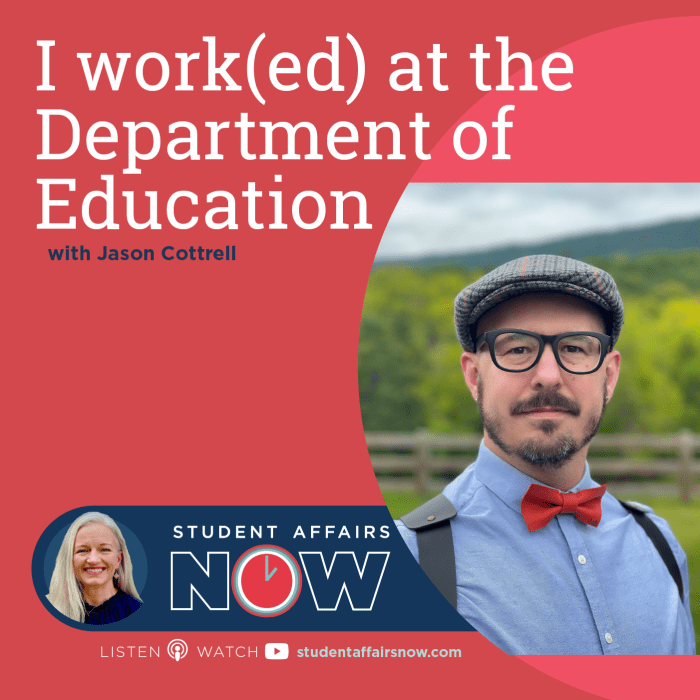
I recently had the pleasure of speaking with Dr. Heather Shea on the Student Affairs Now podcast about my experience at the U.S. Department of Education. We discussed my day-to-day work, key developments that have taken place, what may be on the horizon, and where I see my journey heading next. Feel free to tune in on your favorite podcast platform or watch the full conversation on YouTube.
April 8, 2025
Reflections on Change: A Personal Journey Through Education and Public Service
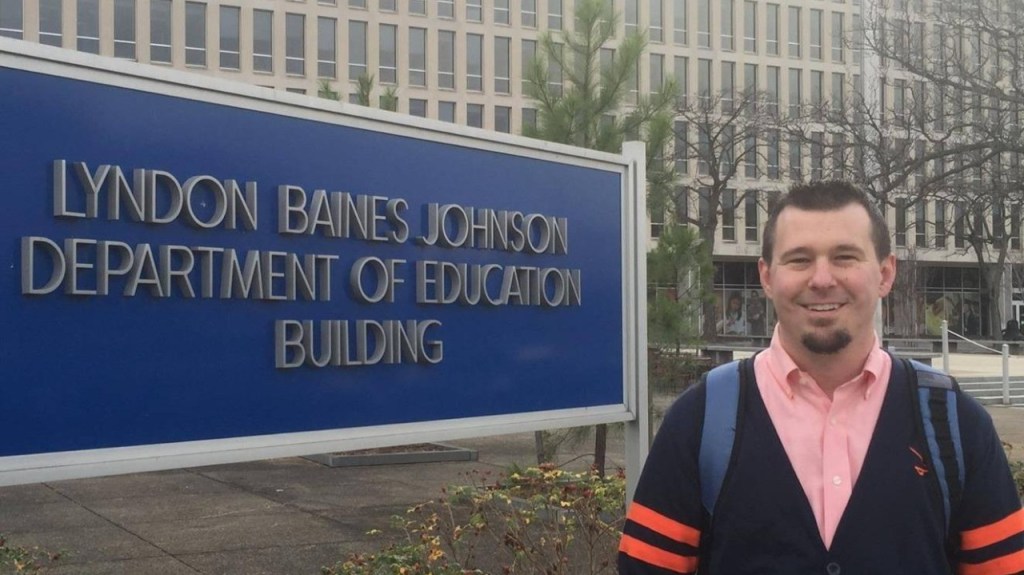
For the past few weeks, I’ve been contemplating what to write about. While I’m certain that the focus of this blog will be on postsecondary education, I’ve wrestled with two directions. One approach is to dive into the future of higher education and student affairs from an evidence-based perspective. The other is to offer a snapshot of the field as it stands today—its current context. Ultimately, I believe I can blend both themes together, weaving them into my reflections in ways that align with my blog’s name, “Thoughts, You Just Fold Them In.”
Nearly a month has passed since a major announcement shook the landscape of education. Just days after the new U.S. Secretary of Education swore an oath to protect the Constitution, she made the unprecedented decision to reduce the force of the Department of Education (ED) by half. This move was soon followed by a proposal to dismantle the Department entirely. We will talk about the decision to begin moving pieces of ED around in the coming weeks.
For those familiar with my background, it’s no surprise that this decision had a profound and personal impact. I was one of the 1,300 people who received a “RIF notice” (Reduction in Force). After nearly nine years working at the U.S. Department of Education, I now find myself pivoting toward the next step in my professional journey. We hope to remain in the National Capital Region, so my search is geographically constrained. I am searching from North of Baltimore to Northern Virginia and Hagerstown to Annapolis, if you know of anything. A few years ago, I could have easily seen myself retiring from the Department. Clearly, that won’t be happening now.
At first, I felt a mix of sadness and frustration—emotions that lasted about two days. Since then, I’ve come to terms with the change. While it’s still surreal, I’ve found peace with it. I’m truly focused on what’s next for me.
The most surreal part of all of this is the fact that I’m now a part of this American story. Civil servants are typically behind the scenes. We do the work that supports the public, keeping the country running smoothly. But now, I find myself directly involved in a historical moment. In the future, I’m sure I’ll reflect more on my experiences with the Department, but for now, I’m more concerned with where my career is headed next.
A few weeks ago, I shared a lengthy thank-you on LinkedIn to colleagues who shaped my journey. In that post, I also touched on why I chose education as my profession and how committed I’ve always been to public service. I truly believe that education is one of the most noble careers one can pursue. I also believe that public service—as an educator, within government, or through government initiatives—has an unparalleled ability to positively impact people. As an employee of ED, I directly influenced every corner of this country by supporting teachers, schools, parents, and organizations to help our nation’s students thrive.
Education was my calling long before I started working at the Department. When I was in college, I had the privilege of working with incredible mentors who guided me when I wasn’t sure which direction to take. I’ve always been drawn to roles where I could help others, and my natural affinity for structure and organization helped me thrive in those environments. After applying to several graduate programs, I found the perfect fit. Through various campus-based roles, three degrees, and eventually a move to Washington, D.C., I found my purpose: making a meaningful impact in education.
But then, the unthinkable happened. Under the rhetoric of figures like Linda McMahon and Donald Trump, people like me—civil servants working in education—were labeled as wasteful, part of a bloated system, and even as part of the mythical “swamp.” That narrative was deeply painful—and it still stings. But I want to say this loud and clear to my fellow educators: we are not failing our students. We are, in fact, one of the most impactful and successful groups of professionals in this country. Without educators, our nation would not have achieved the progress it has.
I hope the stories and research I share on this blog will help drive home this message. My lens will be focused primarily on higher education and student affairs, but the overarching message applies to all of education. If it weren’t for the teachers who guided me, the student affairs professionals who challenged me, and the colleagues who consistently offered new perspectives, I wouldn’t be where I am today. I’m a kid from the rural Shenandoah Valley who never imagined succeeding in college. Yet, I became the first in my family to earn a degree—and eventually a master’s (from Virginia Commonwealth University) and a PhD (from the University of Virginia). I owe all of that to the teachers who shaped my journey.
We owe a huge debt of gratitude to our educators. It’s important that we never forget their role in our success—whether as individuals or as a nation.
I thank them today and every day.
Jason C.
 Dr. Jason Cottrell